

In 2018, Microsoft faced a crisis: surveys showed that entire groups of high-performing employees in their Surface and xBox divisions were miserable. These employees had specialized skills and would be hard to replace if they started quitting. Microsoft was finally making headway in hardware and the wrong employees leaving risked undoing their progress.
The head of the hardware division began to focus attention on the problem. He and his staff explored what they believed to be the most likely culprits: overdemanding managers or employees having to work odd hours to support their global supply chain. None of these explanations panned out. They turned to Microsoft’s organizational analytics team to conduct a study… on employee misery.
The analytics team hit many dead ends before finally breaking through while they were crunching the numbers on meetings. Employees were spending an average of 27 hours a week in meetings, which was typical for Microsoft at the time. People in other divisions were quite happy despite this meeting load, so it wasn’t the sheer hours.
They discovered it was not a question of the number and length of meetings, but how many people were in the room. The most miserable employees were attending meetings with 10, 20, even 30 people in the room. In these meetings, two or three people would take up all of their time while the rest of the room listened passively.
Little progress was made during these meetings, and these meetings ate up the time necessary to do focused work. Nights and weekends were the only times free from meetings, and this became the “real” workday. The high performers Microsoft was most at risk of losing were the ones who had restructured their lives around the problem.
The Physics of Coordination
Twenty-seven hours a week in meetings sounds extreme until you look at the data on how most organizations actually spend their time. Across industries, roughly 60% of knowledge workers’ time goes to coordination activities, leaving just 40% for everything else. As bad as 40% sounds, it overstates the time available for real work. Microsoft’s own telemetry shows employees are interrupted every two minutes by meetings, emails, or notifications. Research on sustained concentration suggests that deep work requires at least 15 uninterrupted minutes to begin and much longer to produce anything of value. In most organizations, the calendar makes this arithmetically impossible during working hours. How did this become the default?
The load-bearing assumption is that coordination costs scale combinatorially with team size, and this necessitates meetings. The math behind it is simple: coordination costs scale with the square of headcount (n * (n - 1) / 2). Thus, the enormous amount of time spent in meetings at scaled organizations is a mathematical inevitability, the cost of reaching scale.
This mathematical truth does not survive first contact with the reality of work.
I was an early engineering hire at an online consignment marketplace in 2013. The company grew, and the engineering team grew with it. By the time the team had eight engineers under one manager, the standups reached a point where I actively tried to avoid listening to what my colleagues were working on. The information was irrelevant to my work, and I didn’t want it taking up headspace. My wife regularly encouraged me to call in sick so I could get work done without putting in another weekend. Was I coordinating with the other 7 engineers in that meeting? Were they coordinating with me? Were the 30 people in meetings together at Microsoft coordinating with each other?
The formula assumes a complete graph, with every member of a team coordinating with every other member. The reality of communication at work looks more like a sparse graph, with few nodes connecting. All employees connect to the manager (hopefully), but there are far fewer work-related connections to each other. This means most of the time attributed to coordination isn’t coordination at all.
An 8-person team has in theory 28 communication paths. Most of those 28 paths carry no useful information, but the organizational machinery acts as if all of them matter. The waste isn’t in the combinatorics; it’s in treating a sparse graph as if it were fully connected.
If people aren’t coordinating in these meetings, what is going on?
What Coordination?
Luna and Renninger give us a clean taxonomy of possible meeting outcomes in The Leader Lab. Meetings can only do three things: share information, generate ideas, or make decisions. Only the last two require people to be in the same room at the same time, and only the last one moves the business forward.
Informational meetings present a serious problem because employees broadly understand that status meetings are useless. A survey conducted by Clarizen in 2015 showed that almost half of employees would rather do any other unpleasant activity, including watching paint dry, rather than attend another status meeting. Yet organizations spend the majority of their time in them anyway. A McKinsey study on time management revealed that executives in the average organization spend 10% of their time in decision meetings and over 50% of their time in status meetings. At the highest performing organizations, this time allocation is inverted.
Everyone from junior employees to executives hate status meetings and studies confirm the instinct. It’s possible to simply delete most of them from the calendar and share the information async. Why do these patterns persist? Asked another way, what forces are so powerful that they demand these meetings in the face of both lived experience and ample data? The answer is that meetings aren’t just consuming time. They’re serving a purpose that has nothing to do with coordination.
The Status Economy
Decades of research in psychology have converged on three needs that are non-negotiable in human functioning. People need to feel effective and masterful in their environment. They need agency over their own behavior rather than being pawns of external pressure. And they need meaningful connections with other people. Psychologists call these competence, autonomy, and relatedness. Deci and Ryan named this Self-Determination Theory. When these needs are satisfied on an ongoing basis, people develop and function effectively and experience wellness. When these needs are unmet, people find it distressing and become less effective.
These aren’t nice-to-haves. They are needs, and people will seek to have those needs met one way or another. The structure of the workday is so dominated by meetings that it leaves employees with very little choice in how their needs are met. When we map the most common meeting pathologies, they tie back to meeting a fundamental need.
Competence. When deep work is impossible because time is fragmented, it becomes difficult to demonstrate competence through output. What’s left? Performance. Polished status updates, impressive decks, and the articulate summary of what your team accomplished. The meeting becomes the venue where competence is displayed because the workday offers no other stage.
Autonomy. When someone’s calendar is controlled by other people’s meeting invitations, autonomy is scarce. Meetings offer a perverse form of it: calling a meeting asserts control over other people’s time. The 60% ad hoc meeting rate is evidence in plain sight. These are unscheduled interruptions that the caller initiates; an act of agency in a system that otherwise offers very little. Inviting someone to your meeting is one of the few unilateral actions available in most corporate environments.
Relatedness. When teams are too large for every relationship to have depth, and when work is fragmented enough that genuine collaboration is rare, meetings become the primary social venue. Being in the room becomes a proxy for belonging. Being excluded from a meeting triggers the same threat response as social exclusion, because in a meeting-dominated workday, it functionally is social exclusion. This explains why meeting audiences tend to balloon. People fight to be included not because they’ll contribute, but because exclusion signals they don’t belong. Many documented human needs (power, approval, achievement) are ultimately driven by the need to belong.
Microsoft’s study confirms the pattern. Large meetings were the key driver of misery, but they didn’t make everyone miserable. They were effective at meeting the needs of those who controlled them.
Imagine a 20 person meeting where three people dominate the discussion. It will almost inevitably be the most senior people in the room doing the talking. In doing so, all of their needs are met. They demonstrate competence by speaking in front of the group, experience autonomy by directing the conversation, and experience relatedness by being at the center of a social interaction. The remaining 17 people are passive, lack agency over their time and the discussion itself, and their presence is interchangeable. Meetings don’t simply fail to meet the needs of most workers, they actively thwart meeting those needs.
Whose needs are met boils down to power. Senior people call meetings, set the agenda for those meetings, and do most of the speaking. Junior people attend and optionally listen. The meeting-industrial complex is a system where people with power meet their psychological needs by consuming the time and attention of people without power. This isn’t a conspiracy. It’s just what happens when meetings are the primary venue for need-fulfillment and access to that venue is determined by hierarchy.
This also explains why the meeting-industrial complex is so resistant to change. The people with the authority to dismantle it are the same people whose needs it serves. The VP who spends their day in back-to-back meetings feels productive. The engineers on their team who can’t get four uninterrupted hours to build features and design systems are the ones suffering, but they don’t control the calendar.
I once worked with a CEO who said “asking your reports about their needs is the dumbest fucking thing in the world because the point of power is that I get what I want and I don’t have to give a shit about what you want.” Few senior leaders would ever say this out loud, but the meeting-industrial complex operates as if it were policy. The difference is that this CEO was conscious of the dynamic. In most organizations, the same asymmetry exists but it’s as invisible as the air everyone breathes. That invisibility makes it harder to address. A problem you can name is a problem you can fix. A problem that feels like the natural order of things just perpetuates itself.
The natural order is not an inevitability. It has been broken before, and the results are striking.
Escape Velocity
After processing the results of Microsoft’s misery study, the leader of the hardware division realized that the problem started with them. They began a sustained effort to reduce the number of meetings and block off focus time on calendars. Microsoft rigorously tracked off-hours work so they could intervene quickly and right the ship where the intended changes were not taking hold. Work-life balance was soon restored and the dreaded exodus never materialized.
Microsoft’s outcome was not a one-off. A 2022 study published in the MIT Sloan Management Review found that reducing the number of company meetings by 40% led to a 71% increase in employee productivity. Shopify purged 12,000 recurring meetings in 2023. Meeting time dropped by 33%, they added 150 FTEs worth of recovered hours, and it became one of the most popular changes in Shopify’s history. Dropbox’s Virtual First initiative limited meetings to debate and decisionmaking. This initiative both improved productivity and became a major retention driver for its employees.
Bain conducted a study on 300 large companies globally. Companies in the top quartile of performance in their industries lose 50% less time to organizational drag, and their employees are 40% more productive. The study found that top quartiles started with the same talent mix as their peers but produced dramatically more output.
Across these examples, the performance gains weren’t just about recovered hours. They were about recovered autonomy, competence, and connection. In other words, their needs were now being met through work rather than meetings.
These companies didn’t achieve these results by asking people to schedule fewer meetings. Structural changes underpinned every success.
When we read the examples, patterns begin to emerge. Shopify deleted the meetings from the calendar rather than asking people to opt out. Dropbox built an entirely new operating model around async-first. Microsoft tracked off-hours work and intervened when the old patterns reasserted themselves. The systems were redesigned so that the old behavior was made difficult.
In organizations where the changes stuck, we also see cultures where status comes from output rather than presence. This shift allows people to sustainably meet their needs through productive means rather than unproductive ones (meetings).
The meeting trap is like gravity, an ever-present force acting in one direction. Shopify imposed a set of constraints after the purge that meant many “default” syncs literally had no valid slot in the operating cadence. Microsoft had to track off-hours work because the old patterns kept creeping back. Extreme measures like these evidence the strength of the force they are trying to overcome. What would it take to change the laws of organizational physics that make unproductive meetings so pervasive?
The answer starts with the unit of organization itself: the team.
The One-Pizza Team
Amazon recognized that team independence is necessary for velocity, but larger teams incur more drag. Amazon balanced these priorities by organizing around the smallest units that could still function autonomously: two-pizza teams (~8 people). This was the right answer in its day; the nature of engineering work made it impossible to shrink the teams further. But this structure leaves significant room for improvement.
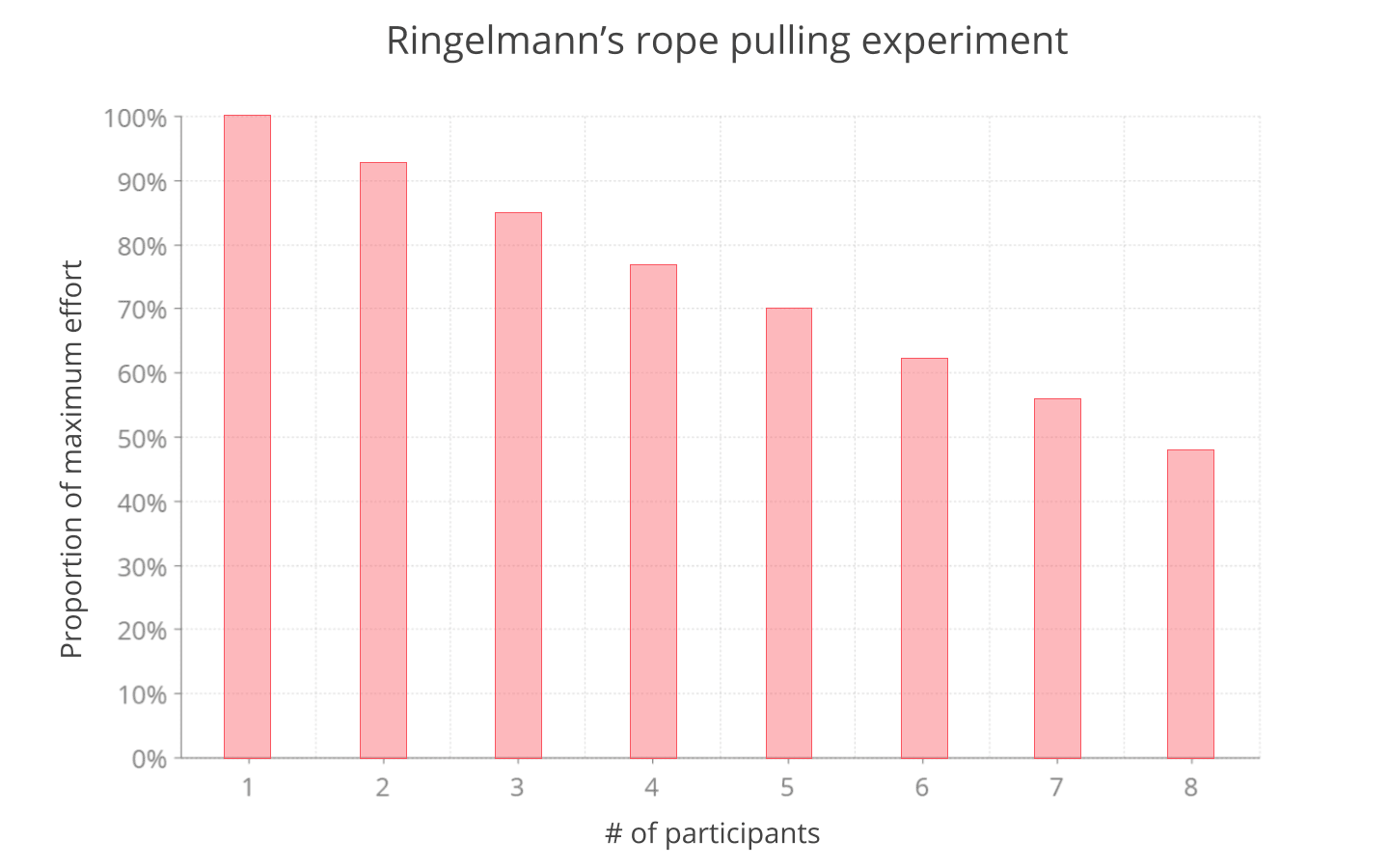
The reason traces to an effect Maximilien Ringelmann discovered while studying rope-pulling. Per-person output drops as teams scale, and the effects are significant. By the time a team has 8 people, their combined output is half of their potential. Research following his initial study has shown us this result is common to every context where it has been tested. When the first study was published, the question was one of cause. Was it a coordination problem, or something else? It was later proven that the main driver is “social loafing”. When teams are larger, people feel less responsible for the outcome and don’t try as hard.
AI agents change this equation by reducing execution cost. Claude Code was built in a week using a small team, and this is representative of where AI is going. It’s not the same work 10x faster, it’s work that was previously impossible for small teams becoming possible. Leaders at AI companies like Imbue and Sundial are already organizing around three-person teams as execution capacity expands. The effects compound: AI agents expand what each person can accomplish, enabling smaller teams. Smaller teams are independently more productive per person: more ownership, less diffusion of responsibility, every contribution visible. The AI multiplier and the small-team multiplier stack. The implications for the meeting-industrial complex are profound.
Under what circumstances would a three person team sitting together hold a formal meeting? Context is naturally shared in small groups, ownership is obvious, and decisions can be made immediately. Competence, autonomy, and relatedness are built into the work itself. It’s difficult to imagine an unproductive meeting, let alone a scenario where such meetings dominate the calendar.
When execution capacity is effectively unlimited, when three people with AI can build what used to take twenty, the scarce resource shifts from “can we build it?” to “should we build it?” and “are we building the right thing?” The constraint moves from execution to sensemaking. This will have significant implications for how organizations are structured.
As small teams close to the work become more self-sufficient, the need for resource allocation and day to day management shrinks. Management shifts to ensure coherence, that teams are tracking roughly in the same direction and solving problems that matter. Flatter structures become possible as the work that justified the hierarchy is absorbed by the teams.
Structure alone isn’t enough. The deeper question is what the organization rewards.
When status comes from visibility, presence, and convening power, meetings become the primary path to feeling competent, autonomous, and connected. The meeting industrial complex is dismantled not by demanding fewer meetings, but by changing where meaning and status come from.
The organizations that escape the trap do so by providing better ways for employees to meet their needs. Competence comes from what you shipped, autonomy comes from genuine ownership, and belonging comes from being on a team where your presence matters. This is a choice leaders must make. When the organization provides better channels for fulfillment, the meetings disappear on their own.
Ryan, we spoke at the kava place last Friday. Digging your post. Thanks for giving me a reason for downloading Substack
I feel this approach to changing how to adapt our work is brilliant and shows that a positive reinforcement loop with AI is not only possible, but provides a tangible actions leaders should take when introducing AI to their teams.
In my experience the reverse effect is actually more common in industry right now, as leaders initial hundreds of AI projects across their organization so they can setup status meetings on each and every one. And then when the accountants do their work, their conclusion is AI expenses are increasing 1000x the rate of productivity gains, so the answers is to cut headcount to make more room for AI. This creates a vicious negative feedback loop which actually creates AI anxiety.
Thank you for showing us there is another way!