


Turo recently made an interesting change to how it pays hosts.
Historically, hosts selected a protection plan that determined what share of the trip price they kept. In March 2026, Turo introduced Earnings Plans in nine markets, which added another variable to the equation: booking lead time.
The further in advance a trip books, the greater the host’s share.
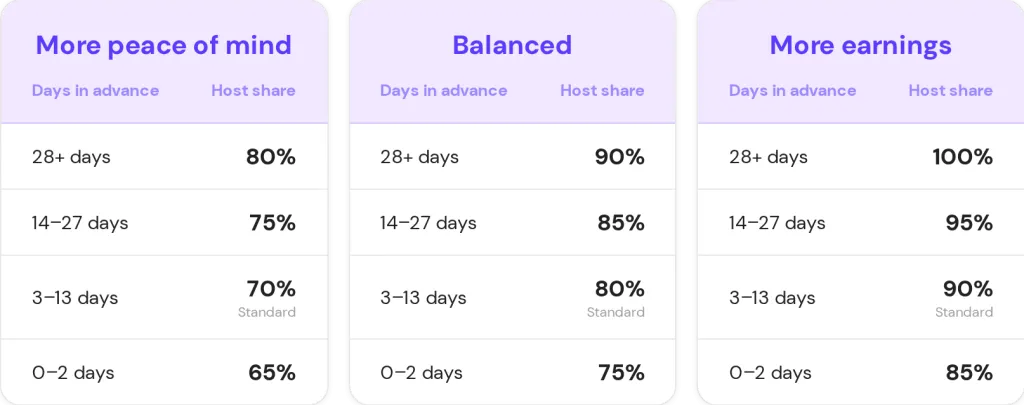
Turo’s explanation is risk. Trips booked further in advance tend to result in fewer incidents and less downtime. I find this fascinating because Turo is effectively telling us something about its economics: lead time predicts the cost of a booking.
I spent some time exploring prices in Turo’s app and found that Earnings Plans aren’t the only place where lead time shows up. Turo appears to price it on at least two other surfaces:
Trip fees increase as lead time falls. Turo layers these fees on top of the host’s rate, allowing it to charge guests more as the risk of the trip increases.
Protection plans become more expensive per day as lead time falls. Guests pay more to reduce their financial exposure on trips Turo appears to consider riskier.
Put these together and a picture emerges. Turo is pricing booking lead time in at least three different places: what the guest pays Turo, what the host keeps, and what the guest pays for protection.
All three mechanisms have something in common: they change the economics of the booking without directly changing the host’s pricing decision.
That raises the question I want to explore: Why can’t Turo fully solve its lead-time problem with the pricing tools it already has, and what is the missing lever?
Why pricing alone can’t solve the problem
Why does Turo have so many short-lead-time bookings in the first place?
Turo has said that more than 70% of bookings occur within 15% of its dynamic pricing recommendation. But that still leaves a meaningful share of hosts setting their own prices, and one behavior among self-pricing hosts is particularly important here: pricing high far in advance, then cutting prices as the date approaches and the car remains unbooked.
From the host’s perspective, this can be perfectly rational. You might hope to get $120 a day when the trip is two months away. If nobody bites and tomorrow the car will otherwise sit idle, $70 is better than $0.
That last-minute capitulation produces exactly the kind of booking Turo’s pricing system tells us it would rather avoid. The host captures the benefit of filling an otherwise empty day, while the incremental costs associated with the late booking disproportionately fall on Turo.
That’s a marketplace coordination problem: the pricing decision is controlled by one party, while another party bears part of its consequences.
Turo’s existing pricing tools can offset this risk, but they can’t fully close the gap.
Trip fees have asymmetric power. If Turo believes a booking is unusually risky, it can increase the trip fee layered on top of the host’s price. But the problem we’re interested in runs in the other direction: the host’s price is too high far in advance. Turo can reduce its fee to encourage an earlier booking, but only until the fee reaches zero. It has effectively unlimited ability to make a trip more expensive and very limited ability to make an overpriced trip cheaper.
Earnings Plans change the payoff, but not the pricing decision. A host who waits until the last minute now keeps a smaller share of the booking, but if the alternative is an empty car earning nothing, accepting the late booking can still be the host’s best decision. The curve makes capitulation less attractive without eliminating the incentive to capitulate.
Dynamic pricing only solves the problem if hosts are willing to delegate pricing authority to Turo. That’s where Turo runs into a different problem: trust.
Turo frequently tells hosts that those using dynamic pricing earn more, but an individual host can’t observe the counterfactual: What would I have earned if I’d priced the car myself?
The host doesn’t particularly care what happens on average. They care what happens to their car.
The marketplace experiences the average. The supplier experiences the variance.
Turo’s promise is impossible to verify. Hosts who believe dynamic pricing sometimes underprices their cars are being asked to surrender control of an asset based on Turo’s claim that they’ll be better off, and Turo benefits when they do.
The missing lever must act upstream on the pricing decision itself, not the payoff after booking.
Understanding the solution space
Turo’s objective isn’t to eliminate late bookings; it’s to maximize the aggregate contribution profit produced by its marketplace.
When I’m thinking about intervening in a system like this, I find it helpful to decompose the metric we’re trying to move. For Turo, I think about it as:
Aggregate CP = Supply × Utilization × Contribution per Booking
Contribution per booking. Turo has told us that trips booked earlier carry lower risk and cost. Any successful intervention therefore needs a credible path to shifting bookings earlier.
Supply. Turo can force hosts toward its preferred behavior, but sufficiently heavy-handed interventions may cause hosts to withhold availability or leave the marketplace altogether.
Utilization. A car sitting unrented produces no contribution at all. The goal is to replace worse bookings with better ones, not merely suppress them.
Importantly, none of these terms needs to improve independently. Turo could rationally accept lower contribution on some bookings, or even lose some supply, if the resulting marketplace produces more aggregate contribution. The danger is optimizing one part of the equation while treating the others as fixed.
That gives us a way to evaluate the available interventions.
Allocating risk and control
There are three broad ways Turo could respond to the misalignment between who controls the price and who bears the cost of a late booking.
Push harder. Turo could steepen the Earnings Plan curve, transferring even more lead-time risk to hosts. At some point, the penalty for a late booking becomes large enough to change host behavior. But this is fundamentally coercive: the host still controls the price, while Turo makes the consequences of getting it wrong increasingly expensive. The host can accept the new economics or exit.
Take control. Turo could instead constrain how far hosts can price above its dynamic pricing recommendation. This acts directly on the behavior creating the problem, but introduces a different risk. If Turo gets the price wrong, the host bears the consequence on an asset they were not allowed to price freely. The host can accept the new terms, withhold availability, or exit.
Couple risk and control. The third option is to give Turo greater pricing authority while having Turo assume more of the economic risk that comes with exercising it. Rather than forcing hosts to delegate control, Turo can offer them something valuable in exchange for it: certainty.
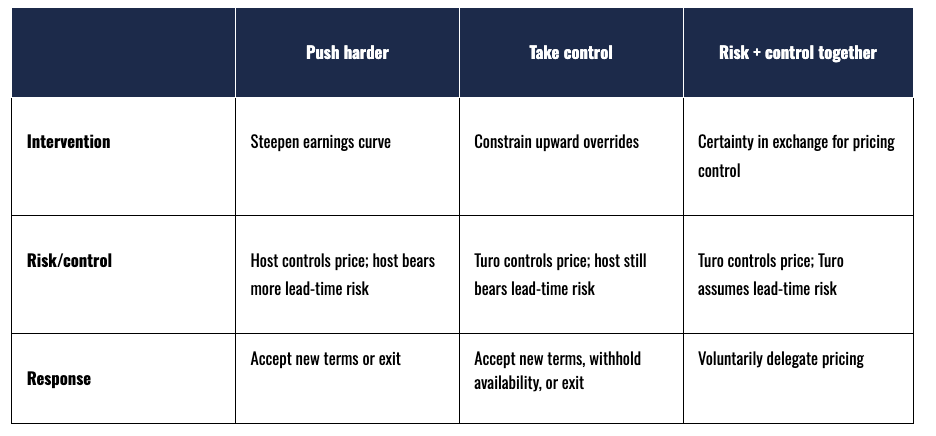
The problem with the first two approaches isn’t that transferring risk or exercising pricing control is inherently wrong, it’s that risk and control remain separated.
Earnings Plans tell the host: you control the price, but you’ll bear more of the cost if the booking happens late. The flaw isn’t that host share varies with lead time, it’s that it varies the same way regardless of who controls the price.
Pricing constraints tell the host: we control the price, but you’ll still bear the cost if we get it wrong.
The third approach makes a different bargain: if Turo wants greater control over pricing, Turo assumes more responsibility for the outcome.
The question then becomes: what could Turo offer hosts in exchange for that control?
Trading certainty for control
If Turo wants hosts to delegate pricing authority voluntarily, it needs to offer them something valuable in exchange. One thing Turo is unusually well positioned to offer is certainty.
Turo operates across millions of bookings. It can pool risk across the marketplace and observe performance across vehicles, markets, and booking windows. Individual hosts can’t. They experience the outcome of a handful of bookings on their own vehicle.
This creates an opportunity. Turo can assume risk that is more costly to the individual host than it is to the marketplace, and charge for doing so through greater pricing control.
There are several ways to structure that exchange, requiring progressively more information and putting progressively more risk onto Turo:
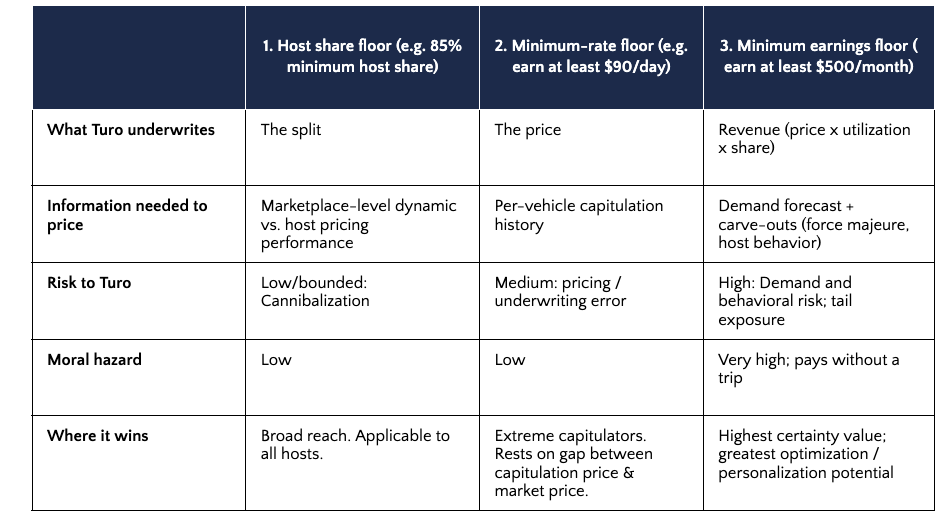
Think of these less as alternatives than as a ladder:
Guarantee the split → guarantee the price → guarantee the outcome.
As Turo climbs the ladder, the certainty offered to the host increases, but so does the risk Turo assumes and the information required to price that risk intelligently.
The simplest place to start is a host-share floor.
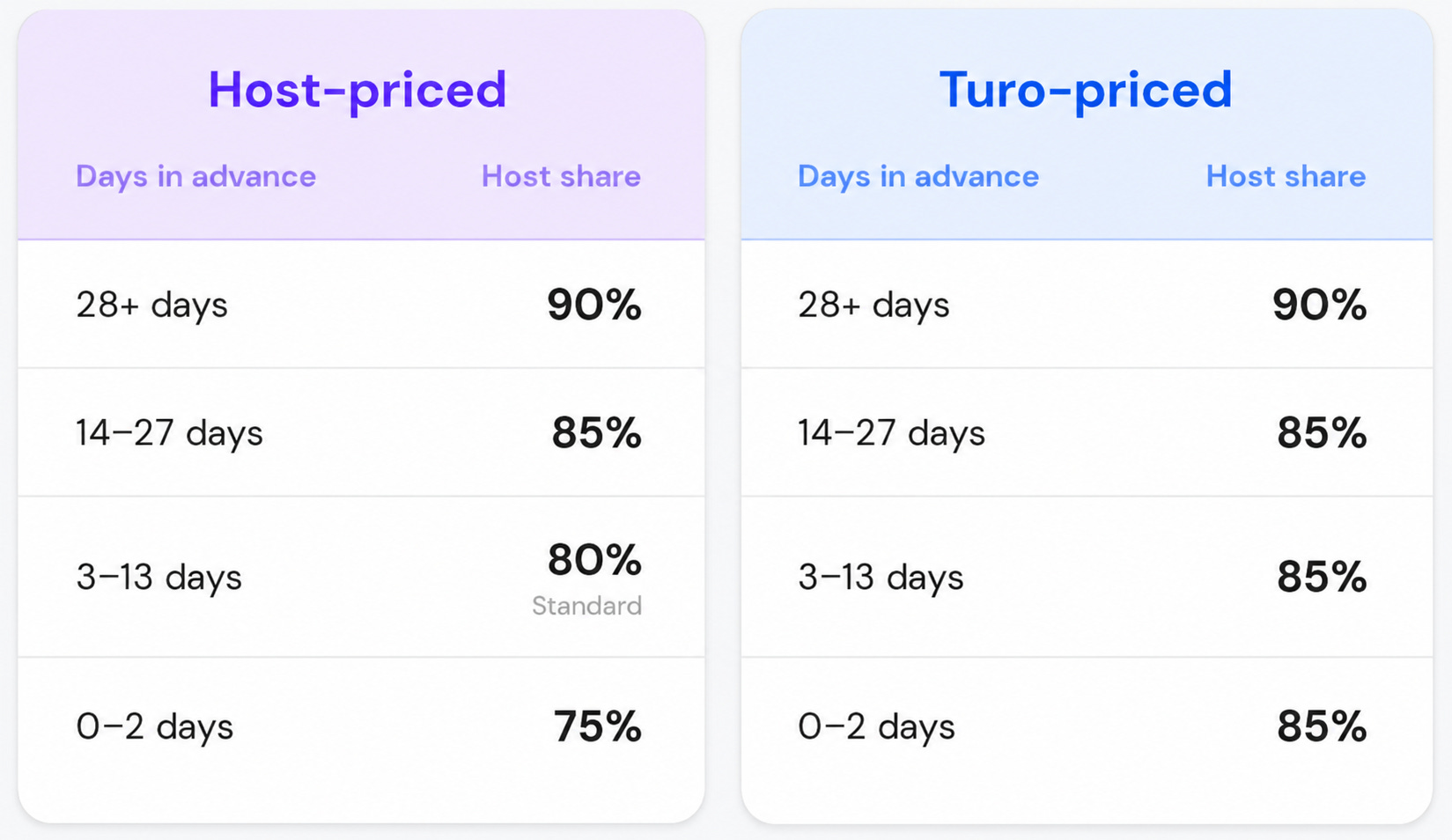
Today, Turo’s Earnings Plans reduce the host’s share as booking lead time falls, regardless of who controls the price. Instead, Turo could guarantee hosts a minimum share—say, 85%—when they delegate pricing authority to dynamic pricing.
The bargain is straightforward: if you control pricing and the vehicle books late, you bear the consequence. If Turo controls pricing and the vehicle books late, Turo bears more of the consequence.
This is attractive as a first intervention because the risk is bounded. Turo doesn’t need to predict the economics of an individual vehicle or guarantee that it will book. It only needs to underwrite the split.
It also works for hosts with no history on the platform. Unlike the more sophisticated guarantees we’ll get to, Turo can price this offer using marketplace-level information.
The next rung is a minimum-rate floor.
One of the central objections to dynamic pricing is that hosts fear Turo will price their vehicle too low. A rate floor addresses that concern directly: delegate pricing authority to Turo, and Turo guarantees that your vehicle will never rent below a specified daily rate.
Imagine a host lists a vehicle at $120 far in advance, fails to book, and repeatedly cuts the price to $70 as the date approaches. If Turo has enough data to believe that vehicle would usually clear at $90, it could offer the host a $90 floor in exchange for pricing control.
The host gets something valuable: protection against the outcome they fear most from dynamic pricing. Turo gets the freedom to price below the host’s aspirational $120 without needing to persuade them that $90 is the right price.
Unlike the host-share floor, this requires vehicle-specific information. Turo needs enough confidence in the vehicle’s demand and pricing behavior to offer a floor the host values while still expecting to earn a return from controlling the price.
That’s why the rate floor belongs further up the ladder: Turo can offer more valuable certainty, but it needs more information to underwrite it intelligently.
The final rung is a minimum-earnings floor.
Instead of guaranteeing the split or the price of an individual booking, Turo could guarantee an outcome: delegate pricing authority and meet certain conditions, and Turo guarantees that your vehicle earns at least some amount (e.g. $500 per month).
This offers the host much more certainty, but it also transfers much more risk to Turo. Turo is no longer underwriting the economics of a booking; it’s underwriting price × utilization × host share. If demand disappears or the vehicle doesn’t book, Turo could still owe the host money.
That creates obvious problems with moral hazard. Any guarantee would need conditions around things like availability and host behavior, along with protections for circumstances Turo can’t reasonably underwrite.
But the potential upside is also much larger. Turo has repeatedly said that hosts using dynamic pricing earn more on average. If Turo can predict that difference with enough confidence, some of that expected improvement can be used to purchase certainty.
Imagine a host currently earns $1,000 per month, while Turo expects it could generate $1,200 with pricing control. Turo could potentially guarantee the host $1,100. The host trades uncertain upside for a higher guaranteed outcome; Turo keeps the remaining upside in exchange for assuming the variance.
Some guarantees will inevitably lose money. That’s fine as long as the portfolio comes out ahead.
If I were running pricing at Turo, I would start with the host-share floor.
It has two properties I look for in an initial intervention: bounded downside and a low cost of learning.
The downside is straightforward. In the worst case, Turo extends the floor to hosts already using dynamic pricing without changing their behavior, effectively giving away margin for nothing.
And unlike the other guarantees, a host-share floor doesn’t require Turo to forecast the market-clearing price or future earnings of an individual vehicle. It can be offered broadly, including to new hosts with no pricing history.
That makes it a relatively simple way to test the underlying proposition: will hosts exchange pricing control for certainty?
If the answer is yes, Turo can climb the ladder as its ability to price and underwrite risk improves.
What needs to be true?
Before investing in an intervention like this, it’s worth asking a simpler question: what would need to be true for it to create value?
I like to start with a break-even model. Rather than trying to forecast exactly how many hosts would adopt the offer or exactly how much value it would create, we can ask: what share of self-pricing hosts would need to switch to dynamic pricing before the intervention pays for itself?
There’s an important cost to overcome. If Turo offers an 85% host-share floor to anyone who delegates pricing authority, some hosts already using dynamic pricing will receive a higher payout without changing their behavior. That’s pure cannibalization.
So the economic test is straightforward:
Incremental contribution from converted self-pricers > cannibalization from existing dynamic pricing hosts
I built a simplified break-even model using publicly available information to test that hurdle. I started with Turo’s final amended S-1 before it withdrew its IPO filing, then layered in the host economics Turo has published and public rental-car pricing data.
The model isn’t intended to produce a precise forecast of Turo’s economics. It’s designed to answer a narrower question: does the hurdle appear low enough that this is worth testing?
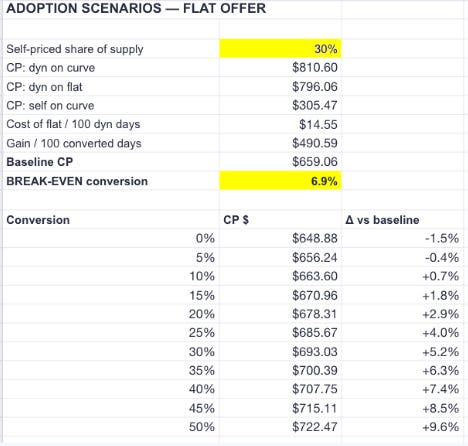
Under the assumptions in the model, the hurdle is surprisingly low.
I assume that 30% of hosts currently self-price and model the intervention described above: Turo offers an 85% host-share floor to hosts who delegate pricing authority.
The result is a break-even adoption rate of roughly 7% of self-pricing hosts. At that point, the incremental contribution generated by hosts switching to dynamic pricing offsets the cost of extending the floor to hosts who already use it.
7% isn’t a forecast. I don’t know Turo’s actual share of self-pricing hosts, its internal contribution curves, or how much earlier dynamic pricing causes vehicles to book. The point of the model is to make those assumptions explicit and see how much they would need to change before the idea stops being interesting.
The model is most sensitive to three things: the share of hosts who self-price, the contribution-profit difference between booking windows, and the lead-time difference between Dynamic and manual pricing.
You can find the model here. Make a copy, change the assumptions, and see where it breaks.
For me, a break-even hurdle this low, combined with bounded downside and substantial potential upside, is enough to justify taking the proposition to hosts. I’d want to understand why self-pricers resist dynamic pricing, whether certainty changes that calculus, and what form of certainty they actually value before designing an experiment.
Who bears the risk?
Turo has already built two pieces of a comprehensive pricing system. Dynamic pricing forecasts demand and coordinates prices across the marketplace. Earnings Plans and trip fees adjust what hosts keep and guests pay based on the expected cost of a booking. What’s missing is the piece that connects them: a reason for hosts to delegate that puts Turo’s own economics behind the recommendation.
That’s what a guarantee does. Turo can tell hosts that dynamic pricing earns more on average, but no host can observe the counterfactual. A guarantee doesn’t require one. The host knows exactly what they’re getting in exchange for control, and Turo is no longer saying trust us. It’s saying if we get this wrong, we pay.
This is also why the host-share floor isn’t just a tactic. Every host who delegates brings more inventory under coordinated pricing, improving Turo’s ability to balance supply and demand. Better marketplace coordination produces more contribution, and some of that contribution can fund the next rung of certainty Turo offers. The offer creates the surplus that pays for the offer.
Turo can make that offer because it holds an advantage no individual host does: scale. It sees millions of bookings and can pool the variance that a host has to live through one car at a time. Marketplaces usually use that advantage to identify risk and pass it along through prices and fees. But it has a second use: the platform can assume risk that is expensive for a supplier to carry and ask for something valuable in return.
This generalizes. When a platform wants to change supplier behavior, ask three questions: Who controls the decision? Who benefits from it? Who bears the downside when it goes wrong?
The question for any marketplace trying to change supplier behavior is: who controls the decision, and who bears the downside when it goes wrong? If those are two different parties, incentives will break down, and there is only one way to reconcile them.
Risk and control must travel together.