

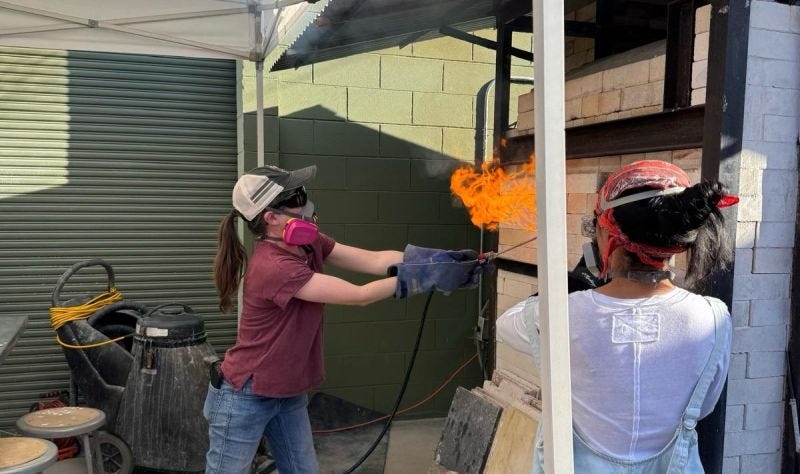
My wife Joanna is a ceramics artist, and I recently joined her for a soda reduction firing. It’s a skilled, labor-intensive process and the entire day, end-to-end, is about 12 hours. She was joined by eight other artists working to expand their range of techniques. The person running the kiln was teaching everyone else how to interpret the shape of the flame, to dial in the backpressure, to recognize what the smell of the combustion is telling them. The day mixed periods of intense activity and obsessive record keeping with long stretches of downtime.
When they had the first stretch of downtime in the morning as the kiln was coming up to temperature, they could have stepped away from the studio, opened laptops, or given attention to any number of the solo projects going on, but they did none of those things. The next order of business, at 9am, was setting up a charcuterie board. This served as a focal point when the kiln did not demand their collective attention.
I went expecting to see a group of artists connecting with their work, and I did. What I did not expect was how the artistic practice would be braided with a group of human beings connecting with each other. Downtime around the charcuterie board wasn’t a break from the practice; it was part of the social fabric that makes a twelve-hour communal firing something people return to. The talk during the downtime was often about the work: readings, measurements, observations when they peered inside the kiln. The connection was mediated by the practice even during the downtime.
Imagine an adult asking another group of adults if they want to spend an entire day hanging out. Many factors conspire to make this a difficult ask. Awkwardness, the looming possibility of rejection, the need to justify all of the other responsibilities of life, feeling like the event might demand more intimacy than the relationship can carry.
Contrast this with “Would you like to spend Saturday firing a soda kiln?”. It’s a sentence anyone can say (at least any potter) without taking on a lot of risk. The activity hands its participants a socially unimpeachable reason to spend an entire Saturday together. It’s an alibi that hides the day’s social function from outside observers, and sometimes from the participants themselves.
Pottery studios in major metros have waitlists over a year long. Climbing gyms are exploding in popularity. Run clubs have become a major social outlet. Ham radio is experiencing a renaissance. None of these activities are new. And yet at this particular moment, something has started pushing people toward serious practice done in the company of others.
Offices, conferences, business travel, coworking were giant alibis for human proximity dressed up as productivity. Until 2020, these activities were unavoidable for most white-collar workers. Remote work, which went from fringe to default almost overnight in 2020, eroded these structures, and they have not fully recovered. AI threatens to finish what co-working started by shrinking teams and hollowing out workforces.
As the structures erode, the demand for connection doesn’t disappear. It has to land somewhere. The categories that can hold it, the ones built around serious practice with built-in downtime, are about to inherit a load they weren’t designed for.
Building one of these is harder than it looks. I know because I tried.
Last year I hosted an event that I called “Crossroads and Confessions: A Dinner of Defining Moments”. This was a curated discussion inspired by The Art of Gathering, focused on the fork in the road decisions that had most defined your life.
These were people I’d known socially for years. The women came. Their partners, who were also on the invitation, did not.
On an episode of Modern Wisdom, Chris Williamson and Matthew Hussey discuss how difficult it is for men to open up with each other when you just put them in a room. But, if you position the same men around a broken lawnmower, everything they’ve been bottling up comes spilling out. The legitimacy of the doing creates the permission for the being. Pretext, pretext, pretext, and the people inside are the better for it.
Simply telling people to “open up more” fails because it ignores scaffolding, context, and the risk people feel being vulnerable. This is why men’s groups and vulnerability circles are not a scalable solution to the presence problem. The price of entry is competence with emotional discourse, so they are unsuitable for people who most need the help. Activity-based presence groups make competence with the activity the barrier to entry, with presence as the byproduct. Astronomy, fermentation, bowling, knitting. There are a hundred doors, and people need only choose one to talk through.
This is where the Crossroads party ran into trouble. The thin alibi the setting provided was in-range for most (but not all!) of the women invited and out of range for most of the men. The needs are universal, but the amount of cover needed to act on them is not. The task at hand is not to fix men or to fix people more broadly. It is to find more broken lawnmowers.
We can identify more suitable activities with a two-part diagnostic: how much mandatory downtime does the practice generate, and how serious does the practice have to be to justify the downtime?
Downtime gives people the unstructured time together they need to connect on a deep level. Activities like climbing and break dancing are great fits because the active periods are so intense that stretches of downtime are physically necessary. Activities like run clubs and curling often come with an explicit expectation of time spent together when the activity is concluded. By explicit, I mean that the first rule of curling is literally “the winners buy the losers’ drinks”. A kiln firing is a good example of an activity that involves babysitting a process, which simultaneously forces proximity and creates downtime. We can contrast this with boutique fitness classes like hot yoga or megaformer pilates. It’s all active time and there are no social expectations, so proximity does not lead to connection.
A serious practice is the bedrock upon which a sturdy alibi is built. Ceramics artists uplevel their throwing ability, their speed, their finesse, their taste in glazing, and their range of firing techniques. Climbers don’t just build up their bodies; they build discernment and problem-solving skills.
The alibi can fail in two directions. Without one, busy adults have no cover for the day. Make the connection the explicit point, the way I did with the dinner, and the exposure scares off the people who need it most. What works is a practice serious enough to justify the hours, with enough slack in it to leave room for everyone to be human.
It is tempting to think AI could fill the gap that it opens. An always-available companion looks like an answer to a shortage of connection. It is the wrong answer, and seeing why shows what these activities actually provide. The one thing we can give each other that no model can supply is witnessing.
People in the activities described aren’t merely present in the same room, they saw each other. Celebrated each other’s successes, lifted people up after their failures. They create a shared memory of having been together that no algorithm and no asynchronous tool can manufacture.
Modernity has built infinite ways to be partially present: laptop open at the cafe, phone out at dinner, Slack on during the workout, getting a podcast in during the run. Almost no remaining context demands our full physical attention for sustained periods. What people will increasingly seek will not be greater fitness or greater skill, it will be hours of permission to be unreachable, inside a context with other people with that same permission. This infrastructure is extremely rare in 2026 and vastly underbuilt for the need that’s about to land on it.
Witnessing is offline, which makes it stubbornly small. It cannot happen en masse, so the shortage will not be solved en masse. There is no platform that fixes this, no company that scales it, no policy that installs it. It gets solved one kiln, one lawnmower, one gathering at a time, by someone willing to create a reason for people to show up.
That someone can be you. Find a practice worth taking seriously, build a little slack into it, and let people in. They will tell themselves they came for the firing, or the climb, or the craft. You will know better, and so will they, and the day will be better for it.
This is very interesting, especially the male female split here
And yeah, it makes a lot of sense. I’m stereotyping here but everyone knows that men kind of want to have some activity to do together otherwise it feels awkward (even drinking or something) While women are perfectly happy together and just meet and talk.
I’ve noticed this when organizing other social events myself
One of the activities that I do like this is downhill long boarding. Though the sport attracts very few women. But the downtime in the sport being walking back up the hill or resting at the top or changing your gear out.
And here’s my chance to share https://youtu.be/lMNfS7747PQ?si=LM8lWIJnr5clPOCm