


The operations team at an online marketplace saw its warehouses rapidly filling up, facing the urgent reality of racks running out of space. Overcapacity was already slowing down operations and on its way tobecoming a full-blown crisis. The team could see that inbound far outpaced sales, and their diagnosis was that the company was listing too much. In response they slowed down listings.
Ops averted the immediate crisis but the problems were only beginning. Growth panicked when revenue fell; leadership decided growth mattered more so growth won the day, putting the problem back on ops. Ops started scrapping inventory to free space. Now finance raised the alarm as costs piled up, but operations won the day this time. This pattern of conflicting teams and the problem bouncing from function to function persisted for two years.
Finally, the product team built an outlet section which offered volume discounts to move excess inventory. The numbers improved and the product team celebrated having finally solved the problem. People moved on and the question of why outlet had been created faded into memory.
Three years later, the company had gone public. They were burning cash at a furious pace with no clear path to profitability. The question that unlocked this problem came not from senior leaders or the teams that had been in conflict about oversupply, but from a seasoned employee who had worked across most of the functions of the company. In an organization where functions worked independently, this individual’s cross-functional visibility was an accident of tenure rather than a design choice.
The reframe was that inventory wasn’t one flow, it was many, and those flows were systematically mismatched: Cheaper apparel and smaller sizes were in perpetual oversupply and this comprised everything selling through the outlet. Once characterized, the problem wasn’t “how do we sell this?” It was “why are we accepting this?” The answer rippled back through the entire system - supply, ops, finance, marketing. Supply and demand finally matched and the company was profitable a year later. Outlet shut down because there was no oversupply left to sell. This reframing didn’t just fix the financials; it corrected a failure of sensemaking.
At each stage the diagnosis made sense. Ops really was out of space. Growth really was watching revenue fall. Product correctly identified price as the most powerful lever under their control. If you had been in the room, you likely would have supported every one of these decisions. None of them were negligent, yet none of them addressed the problem that mattered.
Known, Unknown, and Invisible
Most people in industry have stories like this, where intelligent, well-intentioned people on different teams disagree about the appropriate course of action, and leadership find themselves forcing alignment. A problem solved in one part of the company has unforeseen consequences elsewhere. Symptoms mask problems that are only revealed fully in times of crisis.
One of the most useful ways I’ve found to think about this comes from Leadership Without Easy Answers by Ron Heifetz, who spent his career studying how capable people repeatedly fail in leadership roles.
Type 1: Known problems with known solutions. Heifetz calls problems “technical” when they can be solved by experts with existing knowledge. Think of a surgeon performing a known procedure (e.g. heart surgery), or an enterprise upgrading a software suite.
Type 2: Known problems with unknown solutions. Classic examples include climate change and aging; common business-flavored examples are “our best people keep leaving”, or how to approach technical debt. You can name and measure the problem, and agree on what the problem is, but the path to resolution is uncertain and requires experimentation and discovery rather than a known playbook.
Type 3: Unknown problem and unknown solution. These are sensemaking problems, characterized by seeing symptoms but being unable to locate the cause. Reframing is required to make the problem visible and solvable. The example at the start of this chapter is one such example. Before the reframe: “we have too much inventory” / “we’re not acquiring the right customers” / “our prices are too high.” After the reframe: “we’re accepting supply that doesn’t match demand.”
One of the most common problems Heifetz discusses is people attempting to apply technical fixes when the problem requires adaptation. He defines this as addressing deep-seated conflicts that require learning, mindset shifts, and people doing the work rather than expert fixes. Heifetz was concerned with political economy, but companies often fall prey to the temptation of a quick fix.
The most consequential mistakes are when Type 3 problems are mischaracterized as Type 1 or Type 2. When a problem is assumed to be known when it is not, companies can, and often do, spend enormous resources attempting to solve the wrong problem. The even greater danger is that these solutions mask symptoms, removing urgency and making the remaining signal harder to see.
This is exactly what happened in our example at the start of the chapter. It was three years from outlet to resolution because the symptoms were masked. Over $100 million in losses stemmed not from failed execution, but from solving the wrong problem.
If we return to the opening story, the conflict between ops and growth was, at the time, interpreted as a priority dispute. Ops saw a capacity crisis and growth saw a revenue crisis. This view of the conflict required picking a winner. Picking a winner ended a conversation that had not yet produced understanding.The reality was not two different problems, but two teams seeing different sides of a single problem that neither one of them could name.
What are the signs that we’ve mischaracterized a problem and need to broaden our perspective rather than doubling down? And how can we avoid mischaracterizing problems in the first place?
The Clarion Call of Execution
When solutions fail to solve the problem at hand, a common trap senior leaders often fall into is assuming these failures are rooted in execution. “Failure to understand and execute the strategy” assumes three things are true. First, the problem has been correctly identified. Second, the strategy encodes a valid causal model. Third, disagreement means people didn’t get the memo.
When the problem is Type 1 or Type 2, all of these assumptions might hold. When the problem is Type 3, none of these assumptions hold.
The execution diagnosis is attractive because it preserves authority. Accountability flows in one direction. It also avoids reopening the problem and feels actionable (”execute harder”). A Type 3 diagnosis is uncomfortable because it implies that we don’t yet know what’s wrong, and disagreement is informative. Leadership must hold uncertainty longer, and strategy must remain provisional. Ramping up pressure on execution narrows thinking precisely when solving the problem requires zooming out.
Most leadership selection systems reward decisiveness, confidence, narrative coherence, and speed of convergence. They do not reward holding competing hypotheses, public uncertainty, reversing decisions, and updating beliefs in public. This is why misdiagnosis persists even when signals are present. The signals exist, but the frame makes them hard to see.
Signals in the Noise
There are a few common tells that a problem has been mischaracterized.
The first is when problems are solved locally and produce unexpected second-order effects, often surfacing elsewhere in the organization after the solution is applied. A common trap is assuming that the locus of pain is the locus of cause. This is understandable: the team experiencing the symptoms has the strongest incentive to act, and local intervention is often the fastest way to relieve pressure. In complex systems, treating symptoms locally frequently shifts the burden rather than resolves it, creating new problems upstream or downstream.
A second tell is that solutions are abundant, but explanations are not. When a team cannot agree on why something is happening, yet has no shortage of ideas for what to do, it is almost certainly operating in an unknown-problem regime. This pattern is usually easy to recognize: lots of ideas, lots of initiatives, lots of motion, and no shared causal story. Activity substitutes for understanding.
A third tell is when learning fails to compound. You keep acting, but your understanding doesn’t deepen. Action should generate signal, but signal only becomes learning when it can be interpreted. When the frame is wrong, each action stands alone, epistemically isolated from the last.
These signals are useful diagnostics, but they share an important limitation: they are usually visible through a pattern of failure. By the time they appear, the organization has often already paid a significant price.
The Signal That Arrives First
The single strongest signal that you are facing a Type 3 problem, and the only one that is present before failure occurs, is misalignment between teams. Persistent misalignment is the organization telling you that it does not yet understand the problem it’s trying to solve. In this context, misalignment can show up in two ways.
The first is the familiar one: teams disagree on priorities. The second is subtler: symptoms become visible through deteriorating metrics, and teams cannot agree on what problem they believe they are facing.
Misalignment is treated as noise when in many cases it is distributed signal. Each group has a perspective driven by locally true observations of the system as it intersects with their incentives, mental models, and lived experience. Much like the parable of the blind men and the elephant, no one has a complete picture, but the failure is one of synthesis, not of politics, poor communication, or competing egos.
Performing this synthesis requires a perspective spanning many parts of complex businesses, so this responsibility necessarily falls to senior leadership. This duty is not one of omniscience, but rather of asking the right questions and keeping the process of discovery going long enough for the problem to reveal itself. When teams are in conflict right now, you can ask: is this a priority conflict (we agree on the problem, we’re fighting over resources) or is this a diagnostic conflict (we’re looking at the same situation and seeing different problems)?
Structure also plays a role in problem identification. In our example, the company had no senior leader with dominion over all of the core functions and those functions operated in silos. No single leader had all of the information, so the problem was only revealed through a fortuitous set of circumstances. Structures where senior leaders have a span of control and span of authority that allows them to both have the perspective necessary and to act on it have an advantage.
Before converging on a solution you have to explore the problem by actively seeking perspectives that don’t match, pressure-testing hypotheses, and treating disagreement as information. Only after you’ve converged on what the problem actually is do you diverge again on possible solutions. Two expansions, two contractions.
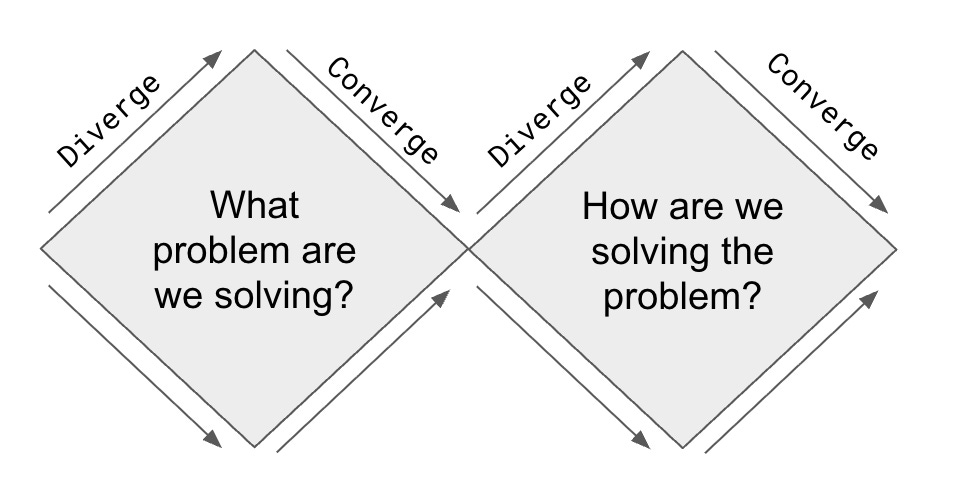
The discipline is in holding the first diamond open long enough. The pressure to skip to solutions is immense. It feels like progress, creates a sense of certainty, and for leadership, externalizes the problem because it shifts the need to one of execution.
This puts leaders in a genuine bind. The same instincts that made them successful, like move fast, project confidence, and drive alignment, become liabilities when the problem is unknown. Slowing down looks like weakness and holding uncertainty looks like indecision. Asking “what if we’re solving the wrong problem?” looks like undermining your own strategy.
One way to handle this conundrum is the executive delegating the power and responsibility of problem discovery to their Chief of Staff. This solves a number of problems. The CoS pressure-tests hypotheses and seeks disconfirming evidence in a role where this behavior is appropriate and expected. Then the executive gets to do what executives do: converge, decide, and act. The decisive behavior is in service of solving the right problem.
This is also politically safer. The CoS can ask the dumb questions, surface the uncomfortable possibilities, float the “what if we’re solving the wrong problem?” question without it looking like the executive is wavering. The exploration happens in a protected space.
The specifics matter less than the principle: When incentives stand in the way of getting the best outcome, the system must be redesigned so this is no longer the case.
The leaders who navigate Type 3 problems well tend to separate two things: confidence in the process of discovery from confidence in any particular answer. They can say ‘we’re going to figure this out’ while also saying ‘we don’t yet know what this is.’ That’s a hard stance to hold, but it’s the only honest one when you’re facing the unknown.
At a system level, we look to processes that counterbalance these instincts. The double diamond does this by making problem discovery an explicit phase with its own discipline: you cannot move to solutions until you’ve pressure-tested competing hypotheses about what the problem actually is. The process can be lightweight. It only requires the discipline to ask, before any solution is proposed: have we converged on the problem, or just on our discomfort with not having an answer?
What Leaders Uniquely Do
When misalignment shows up, the work is to first decode it. Misalignment is rarely the failure leaders think it is; more often, it’s the last honest signal the system has before learning shuts down. Organizations are comfortable diagnosing failures of coordination. They are not comfortable diagnosing failures of knowing.
The most fundamental reframe leaders can make is understanding that problem identification is the job. Leaders don’t solve problems themselves; they have teams who are closer to the work and should be much more capable of solving the problem once it is known. What leaders uniquely do is ensure the organization is solving the right problem. When that fails, no amount of execution excellence can compensate. Execution is how you solve problems. Identification is how you solve the right ones.